Currently Empty: R0.00

The Complete Guide to Water Pressure Problems in South Africa: Causes, Solutions and Prevention
Water Pressure Problems South Africa affects thousands of homes, businesses, farms and industrial facilities every day. Whether you’re struggling with a weak shower, slow-filling storage tanks or inconsistent water flow throughout your property, poor water pressure can be frustrating and disruptive.
Low water pressure is often caused by more than one issue. Municipal supply fluctuations, ageing plumbing, blocked filters, leaking pipes, undersized pumps and even poor system design can all contribute to reduced water flow.
The good news is that most water pressure problems can be identified and resolved with the right approach. At Puritech, we believe every solution should begin with a proper assessment of your water supply and plumbing system and, where applicable, a recent professional laboratory water analysis to ensure both water quality and system performance are considered.
What Is Water Pressure?
Water pressure is the force that pushes water through your plumbing system.
It determines how effectively water flows from the following:
- Taps.
- Showers.
- Toilets.
- Washing machines.
- Dishwashers.
- Irrigation systems.
- Commercial equipment.
- Industrial machinery.
When pressure is too low, water may trickle from taps or appliances may not function as intended. If pressure is too high, it can place unnecessary strain on pipes, valves and plumbing fixtures.
Maintaining the correct pressure is essential for both comfort and equipment longevity.
What Is Considered Normal Water Pressure?
For most residential properties, water pressure should provide a strong, consistent flow from every outlet.
Commercial and industrial facilities often require higher and more stable pressure to support equipment and production processes.
Pressure requirements vary depending on:
- Building size.
- Number of occupants.
- Number of water outlets.
- Elevation.
- Type of equipment connected to the system.
If water pressure changes noticeably throughout the day, further investigation may be required.
Signs You Have Water Pressure Problems
Many people only notice water pressure issues once they begin affecting daily activities.
Common warning signs include:
- Weak showers.
- Slow-filling baths.
- Reduced flow from kitchen taps.
- Washing machines taking longer to fill.
- Dishwashers operating inefficiently.
- Irrigation systems performing poorly.
- Inconsistent water pressure between different taps.
- Pressure dropping when multiple taps are used at the same time.
These symptoms often indicate an underlying issue that should be addressed before it worsens.
Common Causes of Low Water Pressure
There are many possible reasons for low water pressure.
Understanding the cause is the first step towards finding the correct solution.
Municipal Water Supply Issues
Municipal water pressure can fluctuate throughout the day.
Pressure may decrease because of:
- High demand during peak usage times.
- Maintenance work.
- Water restrictions.
- Burst water mains.
- Infrastructure upgrades.
- Supply interruptions.
If neighbouring properties are experiencing the same issue, the municipal supply may be the cause.
Blocked Filters
Many homes and businesses install sediment filters or whole-house filtration systems to improve water quality.
Over time, these filters collect dirt, sand, rust and other particles.
If filters are not replaced regularly, they can restrict water flow and significantly reduce pressure.
Routine maintenance helps ensure both good water quality and consistent water pressure.
Pipe Blockages
Older plumbing systems may develop restrictions caused by:
- Mineral deposits.
- Rust.
- Corrosion.
- Sediment build-up.
These blockages reduce the internal diameter of the pipe, making it more difficult for water to flow freely.
Hidden Water Leaks
Even a small leak can reduce water pressure.
Leaks may occur:
- Underground.
- Inside walls.
- Beneath floors.
- In irrigation systems.
- At pipe joints.
Common signs of hidden leaks include:
- Unexpectedly high water bills.
- Damp walls.
- Wet patches in the garden.
- Constantly running water meters.
- Reduced water pressure.
Prompt leak detection can prevent further damage and restore system performance.
Faulty Pressure Reducing Valves
Many properties use pressure-reducing valves (PRVs) to protect plumbing from excessive municipal pressure.
If a PRV becomes worn or malfunctions, it may restrict water flow throughout the property.
Replacing a faulty valve often restores normal pressure.
Undersized Plumbing
Some buildings were designed with plumbing that no longer meets current water demand.
Adding:
- Extra bathrooms.
- Additional kitchens.
- Irrigation systems.
- Commercial equipment.
may increase demand beyond what the existing pipework can efficiently supply.
In these situations, upgrading sections of the plumbing system may improve water pressure.
Borehole Pump Problems
If your property uses borehole water, pressure issues may be related to the pumping system rather than the plumbing.
Possible causes include:
- Worn pumps.
- Incorrect pump sizing.
- Electrical faults.
- Pressure switch failures.
- Damaged pressure tanks.
- Reduced borehole yield.
A professional inspection can identify whether the problem lies with the borehole or the distribution system.
Storage Tank Problems
Many South African properties rely on storage tanks.
Poorly designed storage systems may result in:
- Inadequate water flow.
- Air entering the system.
- Incorrect float valve operation.
- Low outlet pressure.
- Insufficient tank height for gravity-fed systems.
Proper tank design is essential for consistent water delivery.
Can Water Quality Affect Water Pressure?
Although water quality and water pressure are different issues, they are often connected.
Water containing high levels of:
- Sediment.
- Sand.
- Iron.
- Manganese.
- Scale-forming minerals.
can gradually block filters, pipes, and equipment, reducing water flow over time.
A recent professional laboratory water analysis helps identify these water quality issues so that the correct treatment system can be recommended.
Why Accurate Diagnosis Is Important
Many homeowners assume they need a larger pump when they experience low water pressure.
However, installing a bigger pump without identifying the root cause may fail to solve the problem and could even increase operating costs unnecessarily.
A professional assessment should evaluate:
- Incoming water pressure.
- Water flow rate.
- Plumbing layout.
- Pump performance.
- Storage capacity.
- Filtration equipment.
- Water quality.
Only after identifying the cause can the most effective solution be recommended.
Common Mistakes to Avoid
When dealing with water pressure problems in South Africa, avoid these common mistakes:
- Replacing equipment before identifying the actual cause.
- Ignoring blocked filters.
- Assuming the municipal supply is always at fault.
- Installing an oversized booster pump.
- Overlooking hidden leaks.
- Neglecting routine maintenance.
- Ignoring changes in water quality.
Addressing the root cause saves time, money, and unnecessary repairs.
Why Professional Advice Matters
Water pressure problems are not always straightforward.
A complete assessment ensures that both pressure and water quality are considered before recommending a solution.
At Puritech, we evaluate the entire water system—from the incoming supply to the final outlet—to recommend practical, long-term solutions that improve performance, protect equipment and deliver reliable water flow.
The Best Solutions for Water Pressure Problems in South Africa
If you’re experiencing water pressure problems in South Africa, the good news is that most issues can be resolved once the root cause has been identified.
The right solution depends on several factors, including your water source, property size, plumbing design and daily water demand.
Rather than treating the symptoms, it’s important to identify why your water pressure is low and implement a solution that delivers long-term reliability.
Install a Water Pressure Booster Pump
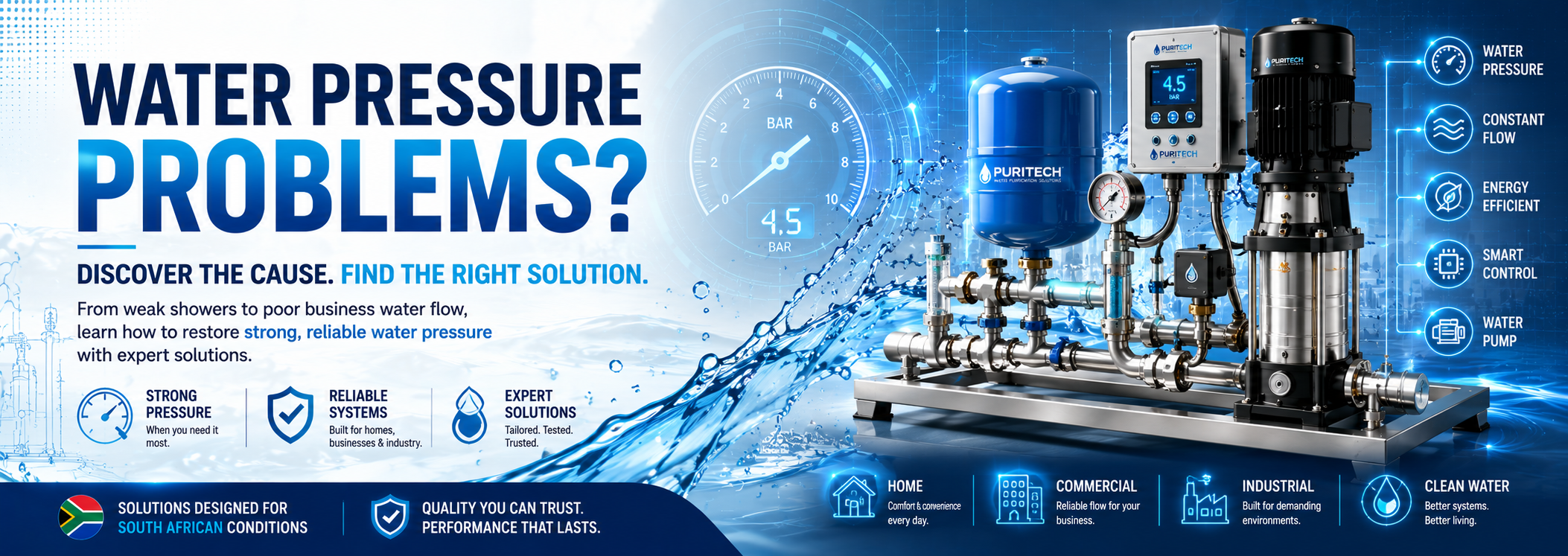
One of the most effective solutions for low water pressure is a water pressure booster pump.
A booster pump increases the pressure of the incoming water supply, ensuring stronger and more consistent water flow throughout your property.
Booster pumps are ideal for:
- Homes.
- Double-storey houses.
- Apartment complexes.
- Offices.
- Hotels.
- Schools.
- Factories.
- Farms.
A correctly sized booster pump can dramatically improve the following:
- Shower performance.
- Tap flow.
- Irrigation systems.
- Appliance operation.
- Water delivery to upper floors.
Choosing the correct pump size is essential to avoid unnecessary electricity consumption and premature equipment wear.
Consider a pressure tank.
Pressure tanks work alongside booster pumps to provide smoother and more consistent water pressure.
They help by:
- Reducing frequent pump starts and stops.
- Extending pump lifespan.
- Maintaining steady water pressure.
- Lowering electricity consumption.
- Protecting plumbing components.
Pressure tanks are especially beneficial for properties with fluctuating water demand throughout the day.
Replace Blocked Filter Cartridges
Whole-house filtration systems protect plumbing and improve water quality, but neglected filters can significantly reduce water pressure.
Sediment, rust, and debris gradually clog filter cartridges, restricting water flow.
If you notice pressure gradually decreasing, inspect the following:
- Sediment filters.
- Activated carbon filters.
- Pre-filters.
- Whole-house filtration units.
Replacing blocked cartridges often restores normal flow almost immediately.
Regular maintenance also improves filtration efficiency and extends the lifespan of downstream equipment.
Repair Hidden Water Leaks
Leaks waste water and reduce pressure.
Even small leaks can have a noticeable impact on your plumbing system.
Professional leak detection can identify problems such as:
- Underground leaks.
- Pipe joint failures.
- Hidden wall leaks.
- Faulty irrigation systems.
- Underground supply pipe damage.
Repairing leaks not only restores water pressure but can also reduce monthly water bills.
Upgrade Old Plumbing
Older properties often have ageing pipework that no longer meets modern water demand.
Common issues include:
- Corrosion.
- Rust.
- Mineral build-up.
- Undersized pipes.
- Damaged fittings.
Replacing ageing plumbing with correctly sized piping improves both pressure and overall water flow.
Service Your Borehole Pump
For borehole users, pressure issues frequently originate at the pump.
Routine servicing should include the following:
- Pump inspection.
- Electrical testing.
- Pressure switch checks.
- Pipe inspection.
- Pressure tank inspection.
- Flow testing.
A well-maintained borehole pump delivers more reliable performance and helps prevent unexpected breakdowns.
Check Your Pressure-Reducing Valve
Pressure-reducing valves (PRVs) are designed to protect plumbing from excessive municipal pressure.
However, worn or faulty valves can unnecessarily restrict water flow.
A qualified plumber can test the valve and replace it if necessary.
This is often one of the quickest solutions to persistent low pressure.
Improve Storage Tank Design
Many South African homes and businesses rely on water storage tanks to ensure a consistent supply.
Poorly designed storage systems may contribute to pressure problems.
Important considerations include:
- Tank size.
- Tank height.
- Pipe diameter.
- Outlet position.
- Float valve operation.
- Booster pump selection.
Properly designed storage systems ensure a reliable water supply during peak demand and municipal interruptions.
Maintain Your Water Filtration System
Water treatment equipment performs best when maintained regularly.
Neglected systems may restrict water flow and reduce pressure.
Maintenance should include:
- Replacing filter cartridges.
- Cleaning filter housings.
- Inspecting valves.
- Checking pipe connections.
- Monitoring operating pressure.
- Servicing pumps where applicable.
Preventative maintenance reduces breakdowns and protects your investment.
Commercial Water Pressure Solutions
Businesses often require more advanced water pressure systems than residential properties.
Commercial applications include the following:
- Restaurants.
- Hotels.
- Hospitals.
- Office buildings.
- Shopping centres.
- Schools.
- Manufacturing facilities.
These systems often require:
- Multiple booster pumps.
- Variable speed drives (VSDs).
- Large pressure vessels.
- Automatic control systems.
- Backup pumping equipment.
Professional system design ensures consistent pressure during periods of high demand.
Industrial Water Pressure Systems
Industrial facilities depend on stable water pressure for production processes.
Pressure fluctuations can affect:
- Manufacturing quality.
- Cooling systems.
- Boiler operation.
- Cleaning processes.
- Production efficiency.
Industrial pressure systems are typically custom-engineered according to:
- Daily water demand.
- Peak flow requirements.
- Operating pressure.
- Process requirements.
- Future expansion.
Farms and Agricultural Applications
Reliable water pressure is essential for many agricultural operations.
Applications include:
- Irrigation.
- Livestock watering.
- Greenhouses.
- Crop spraying.
- Dairy operations.
- Packhouses.
Booster pumps and pressure management systems help ensure water reaches every part of the farm efficiently.
How Water Quality Can Affect Pressure Over Time
Many pressure problems develop because poor water quality gradually damages plumbing and equipment.
Water with high concentrations of:
- Iron.
- Manganese.
- Sediment.
- Hardness minerals.
can lead to:
- Blocked pipes.
- Restricted filters.
- Scale build-up.
- Reduced pump efficiency.
A recent professional laboratory water analysis identifies these issues before they become costly repairs.
Treating the water appropriately helps maintain both water quality and water pressure.
Preventative Maintenance Saves Money
One of the best ways to avoid water pressure problems in South Africa is undergoing routine maintenance.
A preventative maintenance programme may include the following:
- Pump servicing.
- Filter replacement.
- Pressure testing.
- Leak inspections.
- Pipe inspections.
- Tank cleaning.
- Valve servicing.
Regular inspections often identify small problems before they become expensive repairs.
Real-Life Example
A guesthouse in the Western Cape experienced frequent complaints from guests about weak showers, especially during busy mornings.
The owners initially believed they needed a larger municipal connection.
After a professional assessment, Puritech discovered several contributing factors:
- A partially blocked whole-house sediment filter.
- An ageing pressure tank that had lost its air charge.
- An undersized booster pump for the property’s increased occupancy.
Puritech recommended:
- Replacing the filter cartridge.
- Installing a new pressure tank.
- Upgrading to a correctly sized booster pump.
The results included:
- Strong, consistent water pressure throughout the property.
- Improved guest satisfaction.
- Reduced pump cycling.
- Lower maintenance costs.
- More reliable daily operation.
By identifying the actual causes instead of guessing, the guesthouse achieved a long-term solution without unnecessary plumbing alterations.
Choose the Right Solution, Not Just the Biggest Pump
Every property is different.
The best solution depends on:
- Your water source.
- Available pressure.
- Water demand.
- Plumbing layout.
- Water quality.
- Future requirements.
Professional assessment ensures you invest in equipment that solves the problem efficiently rather than simply masking it.
Frequently Asked Questions About Water Pressure Problems
Understanding Water Pressure Problems South Africa helps property owners make informed decisions and avoid unnecessary repairs. Below are some of the questions we are asked most often.
Why is my water pressure suddenly low?
Sudden drops in water pressure can be caused by:
- Municipal supply interruptions.
- Burst water mains.
- Blocked filters.
- Hidden plumbing leaks.
- Faulty pressure-reducing valves.
- Pump failures.
- Electrical faults.
- Empty storage tanks.
If the problem affects only your property, a professional inspection can quickly identify the cause.
Can a booster pump solve every water pressure problem?
No.
A booster pump is highly effective when the incoming water supply is insufficient, but it cannot solve problems caused by:
- Blocked pipes.
- Dirty filters.
- Hidden leaks.
- Faulty valves.
- Incorrect plumbing design.
Installing a pump without diagnosing the problem may increase costs without improving performance.
Does low water pressure always mean I need a new pump?
Not necessarily.
Many pressure issues are caused by maintenance problems rather than equipment failure.
Simple solutions such as replacing clogged filters, repairing leaks or servicing existing pumps often restore normal performance.
Can poor water quality reduce water pressure?
Yes.
Water containing high levels of sediment, iron, manganese or hardness minerals can gradually clog filters, pipes and valves.
Over time this reduces water flow and causes pressure loss.
A recent professional laboratory water analysis helps identify these issues so the correct treatment system can be recommended.
Is low water pressure dangerous?
Low pressure is usually more inconvenient than dangerous.
However, if the cause is a major leak or failing plumbing system, delaying repairs can result in:
- Water damage.
- Increased water bills.
- Structural damage.
- Equipment failure.
- Mould growth.
Prompt diagnosis helps prevent more serious problems.
How often should my booster pump be serviced?
The servicing interval depends on:
- Water quality.
- Daily usage.
- Pump type.
- Manufacturer recommendations.
Routine inspections help identify wear before breakdowns occur and extend the life of the system.
Common Mistakes Property Owners Make
Many people unintentionally make water pressure problems worse.
Avoid these common mistakes:
Buying the Biggest Pump Available
A larger pump does not automatically solve pressure problems.
Incorrect pump sizing can increase electricity consumption, shorten equipment life and even damage plumbing.
Ignoring Routine Maintenance
Blocked filters, worn valves and neglected pumps gradually reduce system performance.
Regular servicing is significantly less expensive than emergency repairs.
Assuming the Municipality Is Always Responsible
Although municipal supply issues do occur, many pressure problems originate within the property’s plumbing system.
A professional assessment can determine whether the issue is internal or external.
Overlooking Water Quality
Poor water quality contributes to scale build-up, blocked filters and restricted pipes.
Treating the water appropriately protects both plumbing and pressure systems.
Real-Life Case Study 1 – Residential Home
A homeowner in Pretoria experienced weak water pressure throughout a newly renovated double-storey home.
The family believed they needed a larger municipal connection.
Following an inspection, Puritech found that:
- The existing booster pump was undersized.
- A sediment filter had become heavily clogged.
- The pressure tank had lost its air pressure.
After replacing the filter, servicing the pressure tank and installing a correctly sized booster pump, the home experienced:
- Strong showers on both floors.
- Improved kitchen tap flow.
- Faster filling appliances.
- Consistent water pressure throughout the day.
The solution cost far less than replacing the property’s plumbing.
Real-Life Case Study 2 – Commercial Office Building
A busy office complex experienced poor water pressure during peak business hours.
Staff regularly complained about slow-flowing taps and unreliable restroom facilities.
Puritech carried out a complete assessment of the building’s water system.
The investigation revealed:
- Increased demand following office expansion.
- An ageing pressure control system.
- Insufficient booster capacity.
Puritech designed and installed an upgraded pressure-boosting system with automatic controls and an appropriately sized pressure tank.
The results included:
- Stable water pressure throughout the building.
- Improved reliability during peak usage.
- Lower pump wear.
- Reduced maintenance requirements.
- Greater tenant satisfaction.
When Should You Call a Professional?
While replacing a filter cartridge is a task many property owners can manage, persistent pressure problems should be investigated by experienced professionals.
Seek expert assistance if you notice:
- Constantly low water pressure.
- Pressure fluctuating throughout the day.
- Noisy pumps.
- Pumps running continuously.
- Visible leaks.
- Unexplained increases in water consumption.
- Frequent equipment failures.
- Poor performance after installing a new pump.
Professional testing prevents unnecessary equipment replacement and identifies the most cost-effective solution.
Why a Complete Assessment Matters
Every water system is unique.
Before recommending equipment, experienced technicians should evaluate:
- Incoming water pressure.
- Flow rate.
- Water source.
- Plumbing layout.
- Pump performance.
- Storage capacity.
- Existing filtration equipment.
- Water quality.
This comprehensive approach ensures the recommended solution addresses the actual cause of the problem rather than simply treating the symptoms.
Why Choose Puritech?
At Puritech, we understand that solving water pressure problems requires more than selling pumps.
Our approach includes:
- Assessing your complete water system.
- Measuring pressure and flow rates.
- Reviewing your water source.
- Evaluating existing plumbing and equipment.
- Recommending solutions tailored to your property.
- Providing professional installation.
- Offering preventative maintenance and technical support.
Whether you’re dealing with a residential property, commercial facility, agricultural operation or industrial site, our goal is to deliver reliable water pressure with long-term performance in mind.
Final Thoughts
Experiencing water pressure problems in South Africa can be frustrating, but the right diagnosis often leads to a straightforward and cost-effective solution.
Low water pressure may be caused by municipal supply fluctuations, blocked filters, ageing plumbing, hidden leaks, pump issues or poor system design. Identifying the true cause before replacing equipment helps avoid unnecessary expense and ensures lasting results.
A professionally designed solution—supported by quality equipment, regular maintenance and, where necessary, a recent professional laboratory water analysis—will improve both water pressure and overall system reliability.
At Puritech, we take a complete-system approach, ensuring your home or business benefits from consistent water flow, efficient operation and dependable performance for years to come.